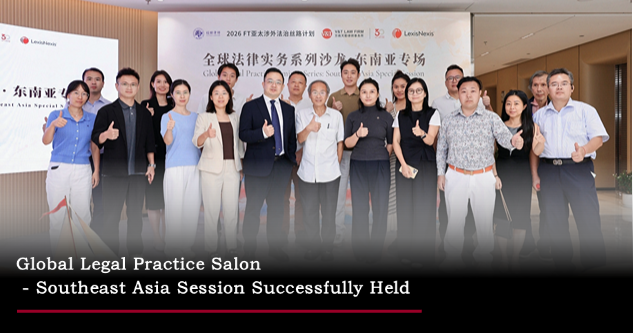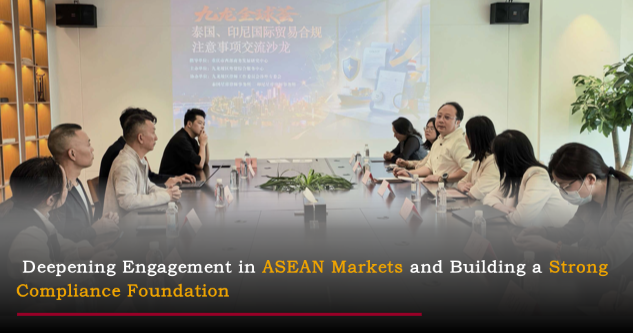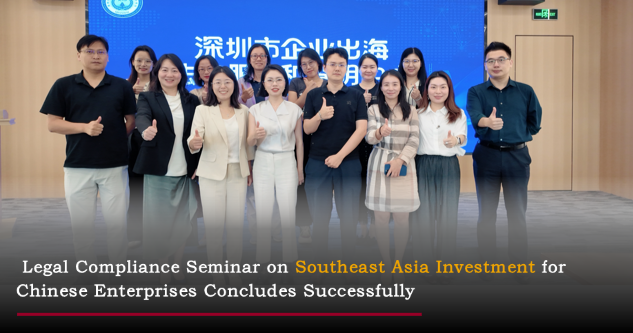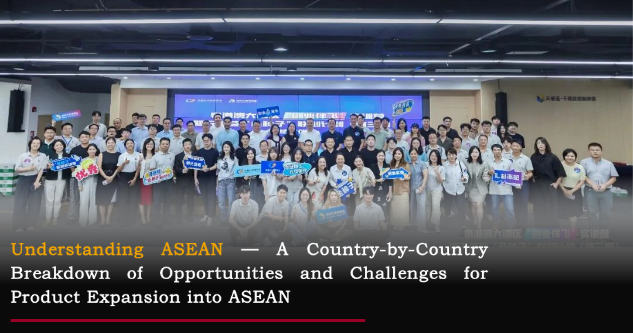

On 16 October 2026, Starry Law Firm hosted in
Qianhai, Shenzhen, a special seminar titled “Chinese Enterprises Going Global
to Southeast Asia: Perspectives on the New Energy Vehicle Industry Chain.” The
event focused on key issues facing the overseas expansion of the NEV industry
chain, including supply-chain restructuring, charging-infrastructure
investment, cross-border data compliance and industrial opportunities in
Southeast Asia.
Attorney Guo Ruoying, Founding Partner of
Starry Law Firm Thailand; Attorney Deng Mingyue, Founding Partner of Starry Law
Firm Indonesia; Attorney Zhao Yifan, Partner of AllBright Law Offices
(Shenzhen); and Ms. Liu Jiaqi, Managing Partner of Starry Advisory, were
invited to share their perspectives. Their presentations provided participating
enterprises with insights from legal, industrial and investment perspectives.

I. A Charging Station Project Is More Than Installing Chargers:
A Comprehensive Compliance Exercise
Attorney Guo Ruoying spoke on “Investing in
Southeast Asia: Market Opportunities and Compliance Entry for New Energy
Vehicle Charging Stations.” She noted that an NEV charging-station project is
not simply the sale of equipment or a site-lease arrangement. It is a
comprehensive undertaking involving foreign-investment entry, electricity
operations, project construction, grid connection, land and building
formalities, and ongoing operations. As NEV ownership and demand for public
charging rise, markets such as Thailand, Indonesia and Malaysia continue to
refine their electric-mobility infrastructure policies.

Drawing on practical experience in Thailand,
Attorney Guo explained that different business models lead to different
foreign-investment entry requirements, electricity-operation qualifications,
allocations of responsibility and contractual arrangements. Only by
systematically assessing the business model, compliance pathway and transaction
structure at the outset can an enterprise effectively identify project risks,
clarify the responsibilities of each party and lay the groundwork for
implementation.
II. Cross-Border Data Governance: NEV Expansion Requires More
Than a Focus on Vehicles and Factories
Attorney Deng Mingyue presented on
“Cross-Border Data Compliance for New Energy Vehicle Expansion.” She observed
that connected vehicles continuously generate and process a wide range of data,
including users’ personal information, vehicle-operation data, location
trajectories, charging and discharging information, driver-assistance data,
exterior images, and data relating to battery management, software upgrades and
safety diagnostics. For enterprises carrying out R&D, manufacturing, sales,
after-sales services and cloud operations across China, Thailand and Indonesia,
data may flow continuously among headquarters, overseas subsidiaries,
suppliers, cloud-service providers and platform operators. Enterprises
therefore need to answer three threshold questions: where the data is
generated, who processes it and where it ultimately flows.

Attorney Deng stressed that the central
question is not simply where data is stored. Overseas sales, remote
diagnostics, OTA upgrades, customer-service systems, charging networks and
supplier technical support can all create cross-border access or transmission
needs. Businesses should evaluate the purpose of processing, data categories,
transfer frequency, recipient permissions, retention periods and technical
measures, rather than treating intra-group transfers as automatically
compliant.
III. Turning Industrial Opportunities into Tangible Returns
Ms. Liu Jiaqi shared observations on regional
industrial division of labour and the economics of overseas manufacturing in
her presentation, “Southeast Asia’s NEV Industry Chain: Market Opportunities,
Entry Pathways and Investment Assessment.” She noted that Chinese NEV expansion
into Southeast Asia is generating new procurement relationships, manufacturing
partnerships and investment opportunities. However, market growth, vehicle
output and component orders do not necessarily move in step. Enterprises must
return to real orders, costs, cash flow and capital investment when assessing a
project’s value.

She further explained that the region’s NEV
industry is developing rapidly while undergoing structural adjustment.
Enterprises should monitor policy, market and supply-chain changes, while
choosing an entry pathway that matches their capabilities. Whether the choice
is product exports, channel partnerships, local production or supply-chain
deployment, it should rest on sound commercial logic and a long-term investment
perspective.
IV. Advancing NEV Expansion into Southeast Asia through a
Whole-Chain Perspective
The event concluded with exchanges among the
participants. From supply-chain commercial substance and charging-station
compliance to cross-border data governance and investment judgement, the
speakers highlighted the issues that NEV industry-chain enterprises need to
address systematically when expanding into Southeast Asia.
NEV expansion is no longer limited to vehicle
sales or overseas factory construction. It is a coordinated undertaking
involving supply chains, infrastructure, data governance and local operations.
Going forward, Starry will continue to draw on its local legal and
industrial-service capabilities in Thailand, Indonesia and other Southeast
Asian markets to support Chinese NEV industry-chain enterprises in investment
entry, project implementation, operational compliance, cross-border data
matters and day-to-day operations, helping them establish a steady presence in
the region.